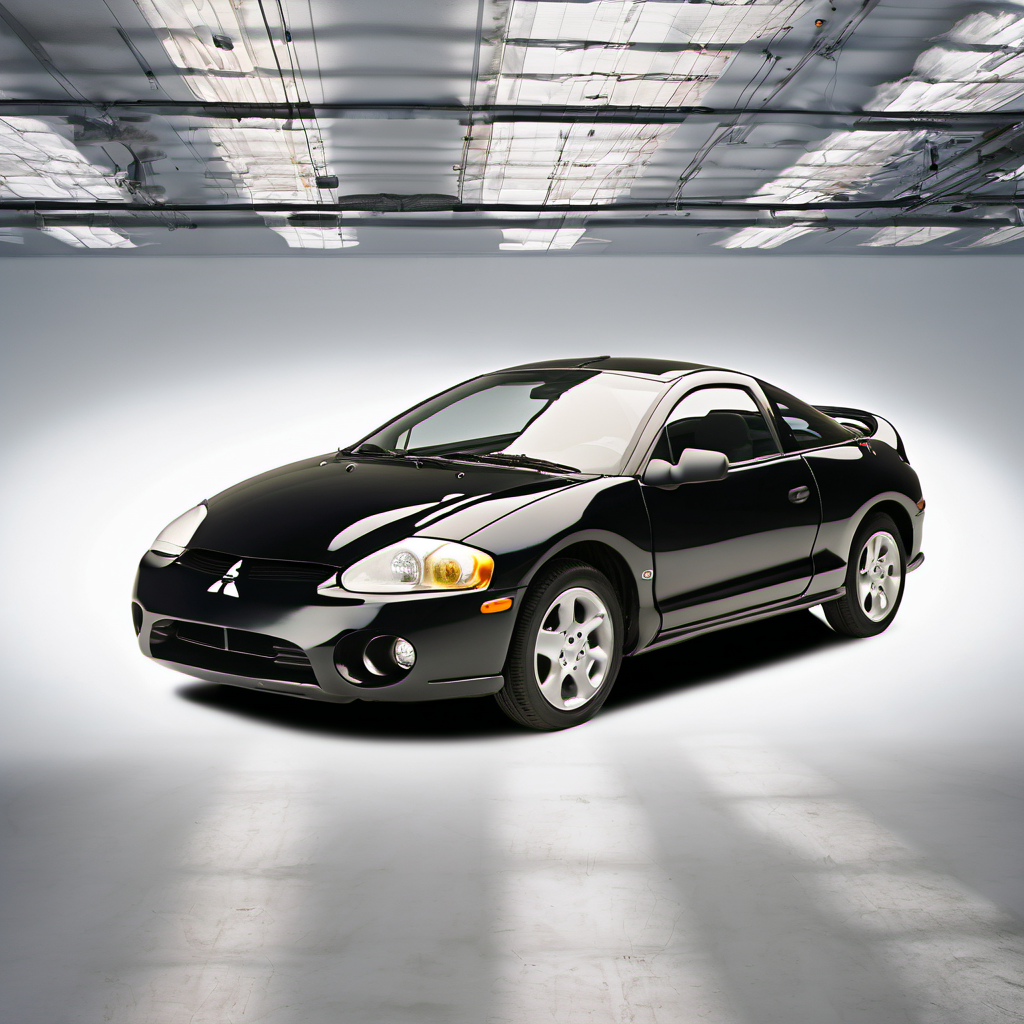
2004 Mitsubishi Eclipse Coupe

2004 Mitsubishi

EclipseCoupe

Coupe

The 2004 Mitsubishi Eclipse is a front-wheel-drive sport coupe in its third generation (3G), which ran from 2000 to 2005. By 2004 the Eclipse had shed its turbocharged, all-wheel-drive roots from the early '90s and settled into a more mainstream front-drive coupe aimed at style-conscious buyers rather than hardcore enthusiasts. The GS trim with the 2.4L four-cylinder is the volume seller — smooth enough for daily driving, with decent highway fuel economy. At 20 years old, these cars are now firmly in high-mileage territory. The 3G Eclipse has a mixed reliability reputation: the 2.4L four is generally more durable than the optional V6, but the platform as a whole carries some known electrical and cooling gremlins. Body integrity and rust are real concerns on Wisconsin examples. Think of this as an affordable, decent-looking daily driver or second car — not a sports car in the modern sense. Parts availability is thinning as Mitsubishi's U.S. footprint has shrunk, so factor in slightly longer wait times at the parts counter.

Reliability
3/5
Verified data
Specs shown for Eclipse Spyder — the most common configuration. Other trims may vary in engine, drivetrain, or fuel economy. Sign in to see your vehicle's exact specs.
Engine
[object Object]
Drivetrain
FWD
Fuel
Gasoline
MPG
20 city / 28 hwy / 23 combined
Seats
Doors
Body
Minicompact Cars

Overview

AI-curated

The 2004 Mitsubishi Eclipse is a front-wheel-drive sport coupe in its third generation (3G), which ran from 2000 to 2005. By 2004 the Eclipse had shed its turbocharged, all-wheel-drive roots from the early '90s and settled into a more mainstream front-drive coupe aimed at style-conscious buyers rather than hardcore enthusiasts. The GS trim with the 2.4L four-cylinder is the volume seller — smooth enough for daily driving, with decent highway fuel economy. At 20 years old, these cars are now firmly in high-mileage territory. The 3G Eclipse has a mixed reliability reputation: the 2.4L four is generally more durable than the optional V6, but the platform as a whole carries some known electrical and cooling gremlins. Body integrity and rust are real concerns on Wisconsin examples. Think of this as an affordable, decent-looking daily driver or second car — not a sports car in the modern sense. Parts availability is thinning as Mitsubishi's U.S. footprint has shrunk, so factor in slightly longer wait times at the parts counter.

Known for
  • Stylish, long-hood coupe proportions that still turn heads
  • Smooth, low-stress 2.4L four-cylinder on the GS trim
  • Affordable entry price on the used market
  • Tighter rear seat than the nameplate's sporty image suggests
  • Front-wheel-drive platform — very different from the AWD turbo Eclipse of the early '90s
Best for
  • Budget-conscious buyers wanting a sporty-looking daily commuter
  • Single drivers or couples who rarely need rear-seat space
  • Buyers comfortable doing some of their own maintenance
  • Short-to-medium commutes where fuel economy matters
Watch for
  • Rust on rocker panels, wheel wells, and undercarriage — especially critical on Wisconsin cars
  • Cooling system neglect leading to head gasket stress on the 2.4L
  • Electrical gremlins including power window regulators and instrument cluster issues
  • Thinning parts supply as Mitsubishi dealers and aftermarket support shrink
  • Modified or track-abused examples — this generation attracted a lot of amateur tuners

Common issues by mileage

6 known

Power window regulator failure

high
Typically appears
60–120k mi
Estimated repair
$120 – $280

Instrument cluster LCD pixel dropout

high
Typically appears
80–150k mi
Estimated repair
$80 – $200

Cooling system hose and thermostat deterioration — can lead to overheating and head gasket stress

medium
Typically appears
80–150k mi
Estimated repair
$150 – $900

Oxygen sensor heater circuit failure — triggers check engine light, hurts fuel economy

medium
Typically appears
70–130k mi
Estimated repair
$120 – $320

Rocker panel and undercarriage rust — accelerated by road salt

high
Typically appears
Any mileage on upper-Midwest examples
Estimated repair
$400 – $2,500

Camshaft position sensor / timing-related faults — often tied to oil sludge from infrequent changes

medium
Typically appears
90–160k mi
Estimated repair
$150 – $500

Maintenance schedule

  1. 1
    Every 5,000 miles or 6 months — whichever comes first Engine oil and filter change

    The 4G64 is sensitive to oil sludge. Longer intervals on an aging engine accelerate cam and lifter wear and can trigger timing-related fault codes.

  2. 2
    Every 2 years or 30,000 miles Coolant flush and hose inspection

    Original hoses on a 2004 are at end-of-life. A burst hose or low coolant on a Wisconsin winter commute can cause rapid overheating and expensive head gasket damage.

  3. 3
    Every 30,000 miles Spark plug replacement

    The SOHC 2.4L uses conventional plugs. Worn plugs cause misfires and reduced fuel economy — noticeable on cold winter starts.

  4. 4
    Every 30,000 miles Transmission fluid change (automatic)

    The 4-speed automatic is a known weak point when fluid is neglected. Fresh fluid significantly extends service life on a vehicle this age.

  5. 5
    Every 2 years Brake fluid flush

    Hygroscopic brake fluid absorbs moisture over time, lowering boiling point. On a 20-year-old vehicle, old fluid also accelerates internal corrosion in calipers and the master cylinder.

  6. 6
    Every 60,000 miles or every 2 years on a high-mileage example Serpentine belt and tensioner inspection

    Original belts are well past service life. A snapped belt leaves you stranded and can damage the alternator and power steering pump.

  7. 7
    Every 15,000 miles or annually Cabin air filter replacement

    A clogged filter strains the blower motor — replacement motors on aging Mitsubishis can be hard to source.

  8. 8
    Every spring after winter road salt season Full undercarriage rust inspection

    Wisconsin salt attacks the rocker panels, subframe mounting points, and brake lines on these coupes. Catching corrosion early is far cheaper than structural repair.

Always defer to the manufacturer's service manual for warranty-mandated intervals.

Cost of ownership

Annual maintenance
$600 – $1,400
Fuel
At 23 MPG combined and ~12,000 miles/year, expect roughly $1,500–$1,800/year at current Midwest gas prices.
Insurance
Generally inexpensive to insure as a low-value older coupe, though sport-coupe surcharges apply for younger drivers. Expect $700–$1,400/year depending on driver profile.

Day-to-day ownership costs are modest if the car is in good shape. The risk is deferred maintenance catching up all at once — a cooling system job plus a transmission service plus rust remediation in the same year can easily exceed the car's market value. Budget conservatively and inspect thoroughly before buying.
Seasonal care

Lake Geneva, WI
Winter
  • Test the battery before first hard freeze — a 20-year-old car likely has the original or near-original battery, and cold cranking amps drop sharply below 20°F.
  • Switch to a full-synthetic 5W-30 oil if not already running it — thinner cold-flow characteristics matter on sub-zero Lake Geneva mornings.
  • Inspect and replace wiper blades with winter-rated units; the low hood line means the wipers take a beating from snow and ice.
  • Top off washer fluid with a rated -20°F or lower formula — standard fluid freezes in the reservoir and lines.
  • Inspect brake lines and caliper slides for rust and corrosion before winter sets in; front-wheel-drive coupes depend entirely on front braking.
  • Rinse the undercarriage at a touchless car wash every 2–3 weeks during heavy salt season to slow rocker panel and floorpan corrosion.
Summer
  • Check tire pressure monthly — heat increases pressure roughly 1 PSI per 10°F temperature rise, and the low-profile tires on the Eclipse are already running near their limits.
  • Inspect the A/C system refrigerant level and cabin filter; a clogged filter reduces airflow significantly in a small cabin that heat-soaks quickly.
  • Watch coolant temperature closely on hot days and in stop-and-go traffic — the aging cooling system on these cars struggles in sustained heat.
  • Inspect rubber CV axle boots for cracking; summer heat accelerates deterioration of boots that may have already been weakened by winter cold.

Comparable vehicles

If you're shopping for one

Red flags
  • Any sign of front-end collision repair — the FWD drivetrain and front subframe are expensive to properly realign after impact.
  • Evidence of amateur engine modifications (intake, exhaust, tune) — the 2.4L was a popular but often poorly executed tuning platform.
  • Soft or spongy rocker panels — structural rust at this point may exceed the vehicle's market value to repair.
  • Burnt or dark transmission fluid — signals the 4-speed auto has been neglected and is likely near end of life.
  • Overheating history noted by seller or seen in temp gauge behavior during test drive — head gasket damage is a near-certain consequence.
What to inspect
  • Rocker panels, wheel arches, and undercarriage floor seams — probe with a screwdriver for soft spots indicating rust perforation.
  • Instrument cluster for pixel dropout or flickering — test in daylight and at night.
  • All four power windows — cycle them fully up and down; slow or jerky movement means the regulator is on its way out.
  • Coolant condition and level — milky or rusty coolant signals head gasket or cooling system neglect.
  • Transmission shift quality through all gears, including from a cold start — slipping or delayed engagement is expensive to fix.
  • Check engine light history with an OBD-II scan before purchase; O2 sensor and camshaft timing codes are common and can indicate deeper neglect.
  • A/C function — recharging an R-134a system this age often reveals leaks at aging seals.
AI profile generated 10 days ago · claude-sonnet-4-6 · v2.